Thursday, April 8, 2010

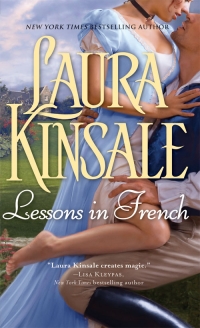
Lessons in French by Laura Kinsale

Why I read it:   
It's by Laura Kinsale. 'nuff said.

What it's about:  
"...Lady Callista Taillefaire [has been] jilted three times in spite of her fortune and her father’s best efforts to find her a husband. Now her greatest desire is to win the silver cup at the agricultural fair with her gigantic prize bull, Hubert. But when Callie’s only old flame returns from his long and mysterious absence in France, her quiet spinster life turns upside down. Dark-eyed, elegant and a magnet for trouble, Trevelyan d’Augustin has given Callie lessons in more than his language in the past. Her father put a harsh and humiliating end to any dreams of romance with a French émigré scoundrel, however, and Callie never thought to see him again. Swallowing his pride, Trev has finally come home to care for his failing mother, but his secrets and misdeeds follow him.Callie soon remembers that nothing is ever peaceful with Trev around. The enormous Hubert vanishes into thin air, one of her former jilts comes back to woo her in a most determined manner—and her bull takes the town by storm! In the midst of these misadventures, Callie finds herself falling in love again with the worst possible man for her."

What worked for me:
In short, almost everything.  Laura Kinsale has a wonderful way with prose.   Like this:-
She stood silent turning the words over in her mind as if they were a strange device that she could not find the key to understand.
I enjoyed the humour of the book. It is sprinkled with litte gems like this one:-
If Major Sturgeon had not been strongly attracted to Mrs. Fowler, Callie would have feared he was coming on with some sort of condition.
I loved the banter between the characters, particularly Callie and Trev:-
"May I make you the object of my violent and unrestrained ardor?"  He made a motion as if to loosen his neckcloth.  "I'm a bit tired, but perfectly willing."
"My calling hours are from twelve to three, if you wish to importune me violently." Callie said, dropping a quick curtsey.
I liked Callie.  I liked how she was a bit clueless (Trev affectionately calls her a "pea-goose") but she wasn't stupid.  I identified with her displacement quite a bit and I guess that's why one of the things which bothered me (see below) bothered me so much.  I liked Trev too.  I enjoyed his efforts to turn himself around and I felt for his fear that he could never do so.  I liked watching Trev and Callie together and really enjoyed how he could effortlessly coax her into outrageous adventures.  I also liked Trev's protectiveness of Callie and her, even unconscious recognition of it.
 She came into his embrace suddenly and fully, making a thankful little sound, as if she'd been having a nightmare and awoken to find safety.
 I liked how Callie wasn't beautiful but Trev found her so.  I really identified with Callie's manner of dealing with difficulty by going into her own head and using fantasy/daydreams to imagine a better reality.  It's something I do myself and I suppose it is one of the reasons I love reading romance so much.  When I have been in hard times, I have lost myself in someone else's happy ending and found a way to get through.

What didn't (work for me):
 Warning:  This may be IS spoilerish. Read at your own peril!
As much as I enjoyed this book (and there is MUCH to love - don't be fooled by the length of this section!), there were things that bothered me.  It was never explained exactly why Major Sturgeon decided to return and court Callie - after all, he had been blackmailed away - what had changed?  There was an inference that he needed money, but that wasn't enough for me.  He could have courted another heiress one supposes.  Why Callie? Why then?

I also questioned why there was (apparently) no consequence to Trev's impersonation at the cattle fair - after all he and Callie were going to be living in the area.  Surely he would be recognised?

I understood the misunderstandings between Callie & Trev.  But, for someone who saw so well and easily into Callie, I was a bit suprised that Trev took so long to "get" that she felt so unlovable after being jilted 3 times.  I suppose though, that Trev was seeing this aspect of her through his own "Trev coloured glasses" so that probably explains it, on reflection.  The rest was exclusive of him, but for this part, he couldn't see past his own stuff.  So, not really a peeve after all.  Huh.

I also didn't quite understand Trev's mother's "miraculous" return to health in the epilogue.  It was too trite and it didn't need to be.  Trev's mother had been dying the whole book - I would not have felt betrayed if she had actually died and the epilogue had merely mentioned that they had had some sadness over that but that she had lived to see them married, etc.  I think that would have been better, IMHO.  

But the worst thing, for me, was the "explanation" in the epilogue as to the real reason Callie had been jilted 3 times.  These events had had a profound effect on Callie.  She was left feeling deficient and she could not escape those feelings, the knowledge of her jilts being so very public.  I could not accept the reason.  What a horrible thing to do to someone.  But, in the epilogue, it seemed brushed over, laughed about and then quickly forgiven/forgotten.  Frankly. that's not good enough.  Callie suffered for 7 or 8 years (depending on how long it was before her first betrothal after Trev left) and there was no guarantee the action taken would get the desired result.  All it was guaranteed to do was to humiliate Callie and leave her alone.  I'm sorry, that's just awful and I couldn't brush it off.  (Okay, now that I've got that off my chest, I feel much better!!).

Also, and this is a small peeve in the big scheme of things, I wanted more love scenes.  I counted only 2 (unless you count the flashback toward the beginning of the book, which I did not).  I wanted more!!

What else?
One of the things I enjoyed best about the book was the way Trev was with his mother.  Take this, for example:-
She smiled and spoke to him in English.  "You enjoyed the assembly?"
"Of course! I engaged myself to two beautiful young ladies and had to leave by the back window.  I've fled to you for aid.  Will you conceal me in your wardrobe?"
She gave a faint husky laugh. "Let the girls meet... on the field of honour," she said in a weak voice.  "Nothing to trouble about."
"But their mothers might pursue me!"
"Alors, I'll dispatch their mothers myself, by poison."
 He squeezed her hand.  "I see now where I come by my unsteady nature."

The little game they played was quite romantic (in the broader sense of the word) but not squicky.  In fact, there are quite a few "games" in this book.   Trev plays a game with his mother - they pretend he is a gallant roue flirting with her to cover the bigger pretense - they pretend that she is not dying.  Trev and Callie play games of adventure and they play at being a married couple at the cattle fair.  Trev and Callie also use playful banter where both say what is truly in their hearts but, disguised as it is as a game, it goes unrecognised.

Callie also plays a little game with Sturgeon at the cattle fair, but mainly she plays games with herself:-
Callie tried to make a daydream for herself.  It was what she always did when she could not quite bear what was real.
and
She had, of course, imagined a thousand times how she would accept the groveling change of heart from each of her suitors, starting with Trev.  He was to have written her passionate, brooding letters and declared that his life was forfeit if she would not have him.  That was after he had become unthinkably wealthy and recovered Monceaux. and declared on his knees that her fortune meant nothing to him and never had.  He would take her penniless from the side of the road and threaten to shoot himself, or sail to Madagascar and become a pirate - which was just the sort of thing Trev would do - if she refused his love.  After suitably ardent persuasion, she would reluctantly give up her plan to dedicate her life to good works and tapioca jelly, and accept his suit.  Afterward they would become pirates together and she would wear a great many pearls and rubies and skewer British officers.

Callie was, however, very careful not to daydream about actually being married to Trev even after he had proposed twice.  That was too real and too painful.  Better a game that was safely a game.


Given the overarching theme of the book, it was fitting that the denouement came at a masquerade ball.  

I had the impression that Callie and Trev would play many games together over the course of their lives - but only the fun and happy ones now.


There is something very special about reading a Kinsale book, the way the words are put together on the page, the characters, that it is a different book each time and not a rehash of the same story.  While this one is not my favourite (that would be Flowers from the Storm - I like the dark and angsty best), this one did not disappoint.  What kept it from being an A read for me was the explanation for Callie being jilted 3 times.  That didn't work for me and kind of took the tarnish off the story.

Grade B+

Monday, March 29, 2010

In For A Penny by Rose Lerner

I bought In For A Penny after reading AnimeJune's review over at Gossamer Obsessions.  Thank you AnimeJune!!


The Blurb:   No more drinking. No more gambling. And definitely no more mistress. Now that he's inherited a mountain of debts and responsibility, Lord Nevinstoke has no choice but to start acting respectable. Especially if he wants to find a wife-better yet, a rich wife. Penelope Brown, a manufacturing heiress, seems the perfect choice. She's pretty, rational, ladylike, and looking for a marriage based on companionship and mutual esteem.  But when they actually get to Nev's family estate, all the respectability and reason in the world won't be enough to deal with tenants on the edge of revolt, a menacing neighbor, and Nev's family's propensity for scandal. Overwhelmed but determined to set things right, Nev and Penelope have no one to turn to but each other. And to their surprise, that just might be enough.


Bouquets: Have you ever, in bright sunshine put on sunglasses and felt your eyes sigh in pleasure?  Have you sat down in a comfy chair at the end of a busy day and felt your very bones sigh in relief?  Sometimes, when I am very fortunate (because, sadly it is not as common as I would like), I pick up a book and after only a page or 2, I heave a happy sigh  - in dual relief and anticipated delight because I know, I just KNOW that I have found a book which will please me from start to finish and I can just settle in to enjoy the experience.  This, for me, was one of those books.  At the foot of page 1 (page 1!!) is this:-
"Lady Ambersleigh did not look delighted when the three young men were announced.  Nev tried to avoid the eye of a young matron on whose new settee he had accidentally upended a punch bowl the month before, and that of an earl from whose son Percy had won almost two hundred pounds at piquet the week before, and that of a lady whom - oh, hell, he tried not to meet anyone's eye."
And that was when I knew.  The tone, the humour, even the sentence structure pleased me.  So, I did a mental happy dance and settled on in.

In For A Penny is not just the title and a play on the name of the heroine.  The theme of "all or nothing" (or, "in for a penny, in for a pound") appears time and time again throught he book; there is Nev who starts off being a very likeable profligate - his life is drinking and playing and very little else.  Then, after his father dies (a father who gambled excessively and very badly, another "all or nothing"), he decides to change - he gives up drinking, his mistress and his friends and throws himself completely into saving the estate.  Penny's response to Nev's proposal surprises even her but she throws herself into it wholly.  She also spends much of the time wholeheartedly showing to all that she is a "lady" (even though she is a Cit and she believes that makes her "lady-ness" (huh, I made up a word) fake).  Even Sir Jasper, on the neighbouring estate, is totally uncompromising as to the rights of landholders vs. the citizenry.   And, through the book, Nev and Penny and many of the secondary characters too, learn where compromise is appropriate (ie, where it doesn't have to be "all or nothing") and where it is not - Nev relaxes enough to enjoy a brandy occasionally, knowing that it won't mean he'll suddenly become a drunken, gambling, wastrel; he suggests compromise between the rioting tenants and himself as landholder but he loves Penny wholeheartedly, holding nothing back.  And, although it is, I think, less obvious, over the course of the book Penny becomes more accepting of her origins and comfortable in her own skin.  

I enjoyed the secondary characters too.  I really liked Penny's parents; I felt for Nev's friends when he dropped them like a hot potato because they were too frivolous for his new life; I felt for the tenants who were struggling with their lot.    Even Sir Jasper had a backstory which made his "villainy" somewhat understandable.  I say somewhat because he was, by the end, crazy 8 bonkers (I don't think that's giving anything away to mention).

I started reading romance at about age 12 and I pretty much believed what I'd read about deflowering virgins in the books I'd read.  Then I was educated (I'm looking at you Kalen Hughes!).  Now, reading a "deflowering" (ugh, what a word!) scene getting it wrong wrong wrong makes me cringe.  This is one of the very few novels I've come across where the position of the maidenhead was correct  - Thank you, thank you, thank you! And, even Nev knew it!  Hooray!  In fact, the love scenes were all realistic, sexy and romantic at the same time and I don't see that all that often either.

Brickbats:  There isn't much to complain about in this book.  The conflict was believable and there was no deus ex machina to solve everyone's problems.  Through compromise and hard work, things started to turn around - this may sound dull but it actually wasn't.   Penny and Nev don't fall into bed, they don't fall in love in a day or even a week, they had to learn how to communicate (and they did!). Nev's description of love (as explained to his sister Louisa) is accurate and, in my humble opinion, no less romantic for being so:-
"Love isn't a game.  Living with someone, being married to her - that's work, Louisa. It's trying to be what she needs even if it doesn't come naturally, and struggling to understand her and working together to make a life!  It's accepting that sometimes things aren't perfect.  It's understanding that sometimes one of you has responsibilities that have to come first and knowing that she understands that too!"
So often, descriptions of love are about how the person makes "me" feel.  While there was a bit of that in the book (well, it's true, after all), it was nice to see the hero recognising the effort, the sacrifice that love is too - the  "it's not just that I think I'd die without him - it's that I'd sacrifice for him", kind of thing.  Nice.
 
If I were to have a quibble, it would be that I didn't have much sympathy with Penny's fears over her lack of aristocratic background.  I identified more strongly with Nev.  That Penny considered for the longest time that Nev could not love her because she was a Cit, especially when she had such loving parents herself, strained a bit for me.  Nev never treated her as less than ladylike despite her fears.  But, that could be a product of my modern upbringing.  I certainly understood it was a concern, I just thought the self-flagellation dragged a little towards the end.    But, as quibbles go, that's not much.


I enjoyed this excellent book very much and will be watching out for future titles by this author. Just thinking about it gives me that happy sigh....

GradeA

Wednesday, March 17, 2010

The Stranger I Married by Sylvia Day

First off, I've decided to start experimenting with review formats til I find the one that suits me best. So, please bear with me while I play.

Second, can I just say that I like this cover much better than the one on the trade paperback issue (you can check it out here if you want).

I was blog hopping the other day and came across a review of this book which reminded me that I had meant to read it. Sadly, I can't now find that particular blog (grr) which is disappointing, because I enjoyed the review and wanted to check it out again... oh well, maybe I'll stumble across it again one day and actually Bookmark it this time!

I remember being intrigued by the premise of this story when it first came out but, not having read anything by this author before, I didn't want to plonk down $30AUD for a trade paperback on a "maybe". Then, it came out in MMP and - I forgot, I guess. Happily with my ereader and the current exchange rate, taking a chance on a new-to-me author became a lot cheaper - about $8AUD instead of about $18AUD for a paperback. (Education on Australian book prices for non Australians over).

Now to the review (still hanging in?):-


What It's About

Isabel, Lady Pelham (or, Pel), is a widow who enjoys her freedom. She has no wish to re-marry but her lovers keep falling in love with her and wanting to marry her (such a problem!). Gerard Faulkner, Marquess of Grayson (Gray) is a certified rake who wants to annoy his mother by marrying someone unsuitable (his mother is a real bitch, no, really). Gray puts an offer to his friend Pel - they will solve each other's problems by marrying. The marriage is based on genuine friendship but is essentially in name only - they will each be free to pursue relationships (or, for Gray, just sex) elsewhere. In fact, he is quite keen for her to continue her lifestyle because this will bother his mother even more.

Gray loves a dainty miss (Emily), his childhood sweetheart, who is married to someone else and falls pregnant with his (Gray's) child. (Notwithstanding his feelings for Emily, Gray still enjoys physical relationships with other women - something about her is too dainty and ladylike for him to let his inner cave man out.)

When Emily dies in childbirth, Gray is devastated by the loss of both mother and child and leaves London.

The story picks up 4 years later, when Gray returns from his self-imposed exile a changed man. (From the blurb on the book, I got the impression that he came back to have a proper marriage with Isabel but actually he comes back to face his responsibility to her - he realises that she is the subject of scorn and gossip and his desertion has made things harder for her.) However, on his return, he finds himself sexually attracted to Isabel in a way he wasn't previously and he decides to pursue her. Initially he doesn't really think about the future - issues of fidelity aren't really on his radar - pretty much he just thinks it will be fun for them to have what is effectively, an affair. As the book progresses Gray realises that Isabel is in fact perfect for him and decides he wants a real marriage with all the bells and whistles.

For Isabel, Gray is a real danger because she feels genuine passion for him and she recognises this feeling from her first marriage. Pelham humiliated her by cheating on her and she protects her heart very carefully from such hurt happening again. Her affairs are always long term, she is faithful during them but ends the relationship when her lover becomes too attached to her. She cares for her lovers, maybe even loves them, but she is not "in love" with them and does not ever become "swept away". She enjoys healthy sexual relationships, however, she has been very careful to pick lovers she likes but who do not inspire a grand passion. Gray does. Isabel finds herself in danger of falling in love with someone who used to be just like her first husband - can she trust her heart to him?


What Worked For Me

Gray and Isabel are friends at the start and they pretty much stayed friends the whole way through. Yay! They know each other's vices and virtues and they are still friends. More yay! The set up was novel (a new twist on the friends-to-lovers trope), the story was well-paced and I liked the characters. I liked how Grey and Isabel actually TALKED to one another as their relationship progressed. No "big mis". Extra more yay! (I even liked how her called her "Pel" even though I find the name unattractive. It signifies their friendship and his level of comfort to be himself with her.)

I enjoyed Gray's total cluelessness about how to "woo" Isabel - the girls had always come to him before and frankly it was all about him - now it was about someone else. (I chuckled at the scene where he is desperate to commence his courtship and is trashing the garden in the middle of the night to find Isabel a perfect rose).

In fact, that was the change in his character after his 4 year absence - a recognition that it wasn't all about him and that he had responsibilities and that fulfilling those responsibilities was rewarding in and of itself. But, he didn't come back fully reformed. He still had work to do and I enjoyed watching him work it out. After he works out what he wants he sets about proving to Isabel that she can trust him and that was fun too.

For me, the story was much more about Gray than Isabel. She had a much shorter journey than he did - she had real trust issues sure, but her essential character remained unchanged. (I did think she was a little unfair to Gray toward the end of the book about the baby thing. In retrospect I think it was more of a device to create a final conflict in order to get the grovel scene and bring us to the end of the book. I wasn't totally sold that her action was consistent with her previously revealed character).

The sex scenes are explicit (hot) and there are quite a few of them but I felt they drove the narrative and were not gratuitous* - it is through these scenes that we see Gray trying to get Isabel to let down her barriers totally to him and her struggle to protect herself from what she fears will bring her undone (as happened with Pelham).

*There was a bit of she's saying "no" but she really means "yes" at the beginning and the in the first sex scene consent was explicitly given a little late in the piece. I don't think it qualifies as forced however.


Peeves (aka What Didn't Work For Me)

Throughout the book, Isabel is described as having auburn hair. I always thought that auburn was a kind of orange red colour. Later, her hair is described as "chocolate with highlights of red". Sorry, that's not auburn, it's just not.

Also, Isabel is described as being a bit of a bombshell - I imagined a Rita Hayworth or a red-headed Marilyn Monroe. She is not dainty or petite. (She's not fat, but she's not small either). But, her hands are described as "tiny".
"Then he felt her hands, so tiny and soft, stroking along the curve of his buttocks...."
I had this mental image of Rita Hayworth with the hands of a cabbage patch doll and it was kinda freaky..


(Actually, I did a search on the word "tiny" in the book and there weren't actually that many times her hands were so described - but I REALLY noticed them and those tiny hands threw me out of the story a bit (pack a bit of weight, those tiny hands...).)

That said, they are pretty small peeves to have. I only mention them because they were "hur?" moments for me.

The secondary romance between Isabel's brother Rhys and Abigail was sweet but when I was thinking about the book later, I didn't really know what attracted him to her. It was a "starstruck lover" kind of story which is fine if you don't think about it too much. Also, one of the barriers to their HEA was her position in society vs. his - but she is the granddaughter of a duke and an heiress to boot, so I didn't see the problem.

I read this in ebook version and when I went to the author's website to get a pic for this review, I noticed that she has posted a "bonus epilogue". Apparently it is contained in the mass market paperback issue but not in other versions. It's only about 4 pages and I thought it was unnecessary and a bit too Snow White with the little bluebirds fluttering around the place - YMMV.


What else

What struck me most about this book when I was thinking about it later was that Isabel was a very unusual character for historical romance - she's sexually independent and she likes sex (what!!). More commonly seen is the woman who doesn't really enjoy sex til the hero comes along with his "mighty wang of lovin'" (TM Smart Bitches Trashy Books). Certainly, Isabel had a grander passion for Gray than for her previous lovers but she did enjoy the physical relationship she had with those men; she was not left unsatisfied by them. And, in her first marriage, the sex was awesome. Only problem was, Pelham started having the awesome sex with every chick in a skirt. Isabel isn't a slut and by modern standards, she not even promiscuous - she has a relationship for like 2 years, then some months single and then she finds someone else - she doesn't bed hop.

During one of the sex scenes, Gray says
"Mistresses do not expect orgasms."
to which she replies:-
"I always have."
(You go girl!!)

Of course the sticklers are scandalised by her but I found it interesting and very refreshing that Gray was not. In fact, there wasn't even a hint that he ever disapproved of her choices at all. So often there is a double standard a hero adheres too - the dichotomy of the wife and the mistress.

Gray did have an issue with the wife/mistress thing but it wasn't from a morality point of view. It was that he had this cockamamie idea that a husband could only have "gentle sex" with his wife whereas he could give a mistress a right good rogering. He worked out fairly quickly that Isabel was made of sterner stuff and she actually liked it when he "lost control" (egads!!). How many romances have there been where the hero totally approves of the heroine's previously acknowledged (and for the time period, correctly characterised as) "scandalous behaviour"? He held her to no high a standard than he held himself. Even when he returned from exile changed in many ways, he still totally approved of her.

I would have liked more exposition of Isabel in Society - one the one hand, she went out a lot and seemed popular and happy but on the other she was gossiped about and shunned and I would have liked just a little more to get a clearer picture of her life and price she had to pay for her independence before Gray came storming back in.

Overall, I enjoyed this book - perhaps a little more than I expected to - and I really liked watching Gray's metamorphosis from a (curiously likeable) asshat to hero.


Grade: B+

Wednesday, January 27, 2010

Don't Tempt Me by Loretta Chase


This is my very first review. Perhaps one of many. Who knows? It's probably not the world's best review, but one has to start somewhere, so here goes!!

I really enjoyed this book. I read it in only a few hours, the pace of the story and the witty repartee between the characters kept me smiling and engaged the whole time.


Lucien de Gray, Duke of Marchmont and Zoe Octavia Lexham knew each other as children. After the death of Lucien's parents, Zoe's father stood in loco parentis to the young boy and his elder brother and the families spent much time together. Lucien and Zoe have a connection even as children. After the death of his brother in a riding accident, Lucien inherits the title. Shortly after, Zoe and her parents travel to Egypt and other exotic locales. Zoe is kidnapped and spends the next 12 years in a harem.

Lucien's reaction to the loss of Zoe, after losing his only brother and his parents, is to shut himself off from emotion, locking his more tender side firmly away. He becomes the epitome of the bored fashionable young lord, taking nothing very seriously and not looking too deeply at anything or anyone.

The book begins when Zoe escapes from the harem and finds her way back to England and her family. She of course, has been more obviously locked away and it is these themes the book explores.

There is the convenient retaining of Zoe's virginity (her "husband" was impotent) but I thought in the end that this was because the book was not about violation, at least, not really. If Zoe had returned to England a non-virgin there were of course numerous issues surrounding a "good marriage" and reintroduction to "polite society". Her keeping her virginity neatly skirted those issues. Others have commented that the plot point was improbable and while this may well be true, I thought, on consideration that the book would have been a very different one without it. I would still have liked to have read it, dark as it would no doubt have been. But, I don't regret the book I did read.

I would have liked to have spent more time with both characters seeing how they felt about what had happened to Zoe in the harem - eg whether Zoe felt violated, virgin or not. I assume that her sexual instruction involved at least someone touching her and in the circumstances, this would amount to a sexual assault but there wasn't anything in the book that hinted at such feelings from Zoe. Similarly, Lucien greatly enjoyed Zoe's sexual abandon and knowledge but did not seem to struggle at all (or much) about how she'd come to learn these "arts". Perhaps because she was only 12 when kidnapped the sexual stuff became "normal" and she didn't suffer for it? I'm not any kind of expert in that area but that's the only theory I could come up with for why she seemed so normal and accepting of her sexual self. She was in no way ashamed and it may be that's what led Lucien not to trouble himself about it.

In any event, the themes of the book were, for me, about imprisonment and freedom. Zoe had been literally imprisoned in the harem and Lucien was emotionally imprisoned by his various tragic losses. (The second half of the book explores other types of imprisonment/freedom but I won't give that part of the story away here.)

When Zoe returns to Lucien's life, she has to learn how to be free and Lucien discovers, much to his dismay, that the "mental cupboard" he has been shoving emotions and memories into will no longer stay closed. Lucien has a very dry wit which I loved and Zoe, used to life in the harem, often says things which are considered scandalous in polite society. Both caused some laugh out loud moments for me - some of the best bits of a Loretta Chase novel in my view.

I love the way Ms. Chase writes and I love Lucien's contrary wit - here's an example:-
Adderwood waved a newspaper under his nose. "Have you seen this?"
Marchmont glanced at it. "It appears to be a newspaper.".
"It's the Delphian. Have you read it?"
"Certainly not. I never read the papers before bedtime, as you well know."
"I should have bet anything you'd read this one."
"I hope you bet nothing. It pains me to see you lose money, unless it is to me."
"But it's all about the Harem Girl."
"Is it indeed?"
"What an aggravating fellow you are to be sure," said Adderwood.... "This" he tapped the newspaper, "appears to be the young woman."
"Certainly not." said Marchmont. "That is a newspaper. We settled that a moment ago. Do you not recollect?"
The chemistry between the h/h was instant and believable. I genuinely liked Lucien and Zoe and would have liked to have spent more time with them.

I thought the book ended a bit soon - it was a fairly short read - coming in a just over 220 pages on my Sony reader but I live in hope that the characters will appear as secondary characters in other books - I'd like to read about Lord Winterton - he was the plot device used to return Zoe to England but apart from that we are told he is "darkly handsome" and that Zoe, despite his good looks, felt no spark with him, he is a cipher. Perhaps we'll get his story next?


Overall, I rated this book an A.

Thank you Ms. Chase for a wonderful read.

Monday, June 1, 2009

It's not really a blog as such

Okay, I haven't really started a blog yet. Maybe I will one day. For now, I have an account. That's a start. Mainly I was trying to get my picture in the little space when I post on other blogs and I think (fingers crossed) that this is how to do it. So, I'm learning about html and teh interweb.!!

Maybe I'll join one of the reading challenges next year and I can post book reviews here. Or not. The world, as they say, is my oyster.